Nobody gives permission for a community to exist.
In 1849, someone donated land on a hill and drew the lines of a town.
It was a reasonable decision. High ground. A crossroads. A courthouse went up. A name went on a map. Lebanon began the way most things begin, because someone with authority decided where the center would be.
Then in 1868, the Frisco Railroad came through.
The landowners on the hill said no. So the railroad laid its tracks a mile south, out in the mud, and built anyway.
A business opened by the tracks. Then another. Families followed. Homes were pulled off their foundations, loaded up, and rebuilt by the railroad. The post office came. The courthouse came.
You’d tie up your horse. Run into someone you hadn’t seen in months. Stay longer than you’d planned. Walk out knowing something you didn’t when you walked in.
Most Midwest towns organized themselves around a courthouse square. Lebanon doesn’t have one anymore. Because it organized itself along something moving, facing outward, toward whoever was coming through.
The hill was chosen for the people.
Downtown was chosen by them.
Frisco Passenger Train arriving in Lebanon, circa 1908-1909. Originally sold by C.E. Clark Post Office and News Store. Shared by Richard Crabtree, Memories of Laclede County MO.
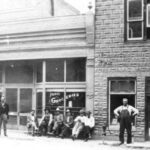
Downtown Lebanon, 1918 – citizens gathering to celebrate the end of World War I. Photo courtesy of the Museum of Missouri Military History.
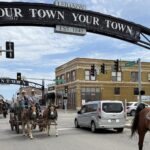
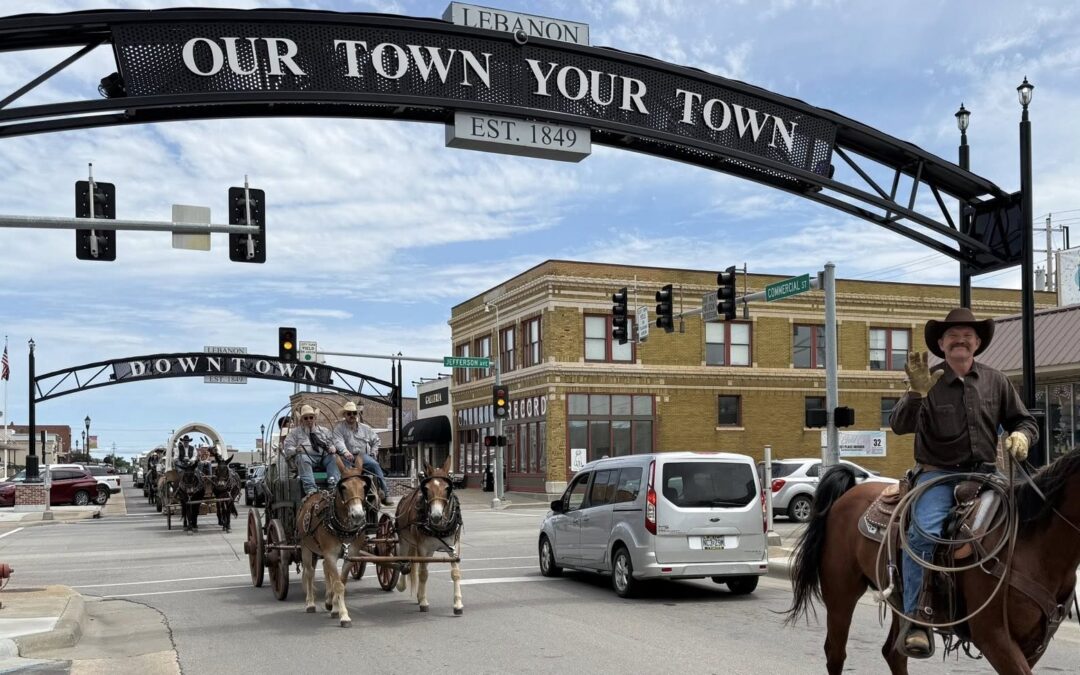
Wagons for Warriors passing through downtown Lebanon, 2025.
-
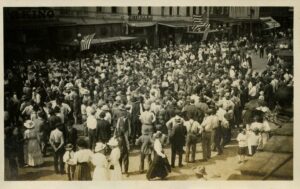
- Downtown Lebanon, 1918 – citizens gathering to celebrate the end of World War I. Photo courtesy of the Museum of Missouri Military History.
-
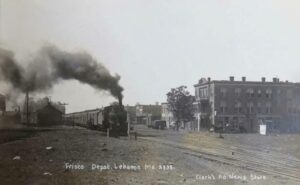
- Frisco Passenger Train arriving in Lebanon, circa 1908-1909. Originally sold by C.E. Clark Post Office and News Store. Shared by Richard Crabtree, Memories of Laclede County MO.
——
Historical photos: Downtown Lebanon, 1918, courtesy of the Museum of Missouri Military History. Frisco Depot, Lebanon, MO, circa 1908-1909, C.E. Clark Post Office and News Store; shared by Richard Crabtree, Memories of Laclede County MO. Modern photo featuring Wagons for Warriors.

This is the Ozarks
Every place carries a story. This is the Ozarks about the history, character, and landscape of the Missouri Ozarks — the towns, the roads, and the people that shaped who we are and why it still matters.
Read more Ozarks stories →